RG CLASSES
Excellence is our standard

NUMBER SYSTEM
Natural Numbers: These are in numerical form of -1, 2, 3, 4, 5, 6, 7, 8, 9, 10..........denoted by N.
Whole Numbers: These are in numerical form of – 0, 1, 2, 3, 4, 5, 6, 7, 8, 9, 10..........denoted by W.
Integers: -9, -8, -7, -6, -5, -4, -3, -2, -1, 0, 1, 2, 3, 4, 5, 6, 7, 8, 9 denoted by Z.
Rational Numbers: All the numbers that can be mathematically written in the form p/q, q ≠0 are known as rational numbers where p and q refers to the integers.
Irrational Numbers: A number‘s’ is known as irrational, if it cannot be mathematically written in the form p/q where p and q are integers and q ≠ 0.
- = 3.1666666, 219921 = 2.33333
- Irrational Numbers
- It is a number that cannot be written as a ratio xyyx form (or fraction). An Irrational numbers are non-terminating and non-periodic fractions. For example: 22 = 1.414
- Complex Numbers
- The complex numbers are the set {a+bi}, where, a and b are real numbers and ‘i’ is the imaginary unit.
- Imaginary Numbers
- A number does not exist on the number line is called imaginary number. For example square root of negative numbers are imaginary numbers. It is denoted by ‘i’ or ‘j.
- Even Numbers
- A number divisible by 2 is called an even number.
- For example: 2, 6, 8, 14, 18, 246, etc.
- Odd Numbers
- A number not divisible by 2 is called an odd number.
- For example: 3, 7, 9, 15, 17, 373, etc.
- Prime numbers
- A number greater than 1 is called a prime number, if it has exactly two factors, namely 1 and the number itself.
- For example: 2, 3, 5, 7, 11, 13, 17, etc.
- Composite numbers
- Numbers greater than 1 which are not prime, are known as composite numbers. For example: 4, 6, 8, 10, etc.
Important Formulas of Number System
1 + 2 + 3 + 4 + 5 + … + n = n(n + 1)/2
(1² + 2² + 3² + ….. + n²) = n ( n + 1 ) (2n + 1)/6
(1³ + 2³ + 3³ + ….. + n³) = (n(n + 1)/2)²
Entirety of first n odd numbers = n²
Entirety of first n even numbers = (n + 1)
Mathematical Formulas
1. (a + b)(a – b) = (a² – b²)
2. (a + b)² = (a² + b² + 2ab)
3. (a – b)² = (a² + b² – 2ab)
4. (a + b + c)² = a² + b² + c² + 2(ab + bc + ca)
5. (a³ + b³) = (a + b)(a² – ab + b²)
6.(a³ – b³) = (a – b)(a² + ab + b²)
7. (a³ + b³ + c³ – 3abc) = (a + b + c)(a² + b² + c² – ab – bc – ac)
8. when a + b + c = 0, then a³ + b³ + c³ = 3abc
For ‘a’ and ‘b’ positive real numbers the following entities will be true:
- √ab = √a √b
- √(a/b) = √a / √b
- (√a + √b) (√a - √b) = a - b
- (√a + √b)2 = a + 2√ab + b
- (a + √b) (a - √b) = a2 - b
- (a + b) (a - b) = a2 - b2
notes
Co-prime numbers are two numbers that have no common factor other than 1 , A set of co-prime numbers should consist of at minimum two numbers. Co-prime numbers, for example, {4 and 7}, {5, 7, 9}
HCF and LCM
The LCM and HCF of two numbers share a relationship with each other. This is expressed in the form of a formula. The HCF and LCM formula of two numbers 'a' and 'b' is expressed as
HCF (a, b) × LCM (a, b) = a × b
Relationship Between HCF and LCM
Formula:
HCF (a, b) × LCM (a, b) = a × b
Rational number
a rational number is of the form p/q, where ‘p’ and ‘q’ are integers and q≠0.
Types of Rational Numbers
Basically, there are different types of rational numbers are:
- Integer values as -3, 0, 3, etc., are rational numbers.
- Fractions values whose numerators and denominators are integers like 1/7, -2/5, etc., are known as rational numbers.
- Terminating decimals like 0.356, 0.711621, 0.97, etc., are rational numbers.
- Non-terminating decimals consist of repeating patterns (after the decimal point) such as 0.3333333…, 0.141414141414…, etc., are rational numbers. These are known as non-terminating repeating decimals.
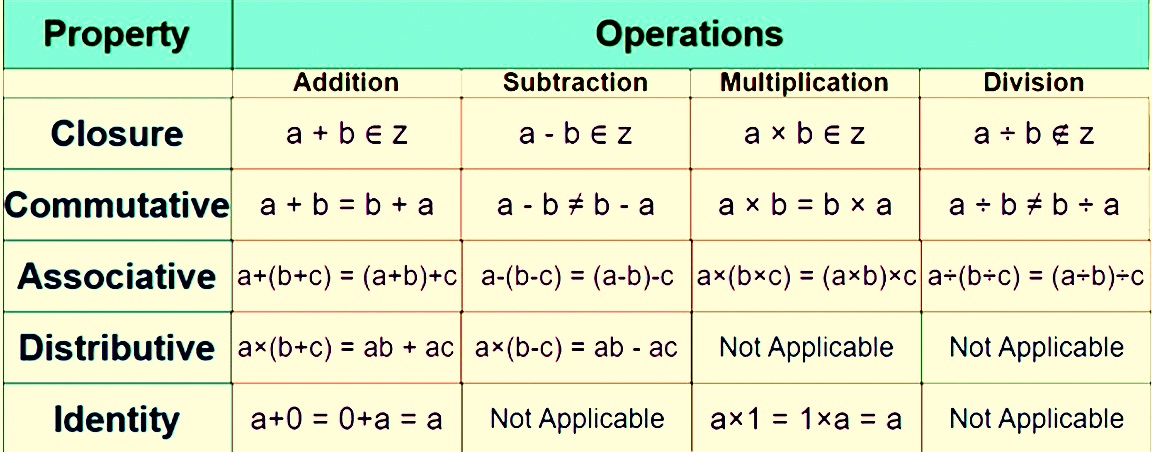
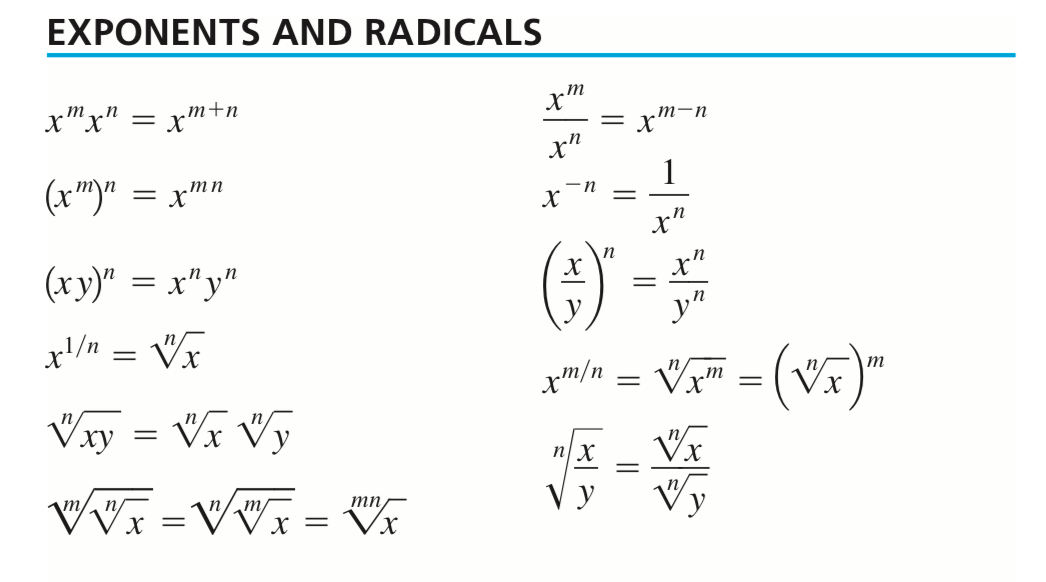
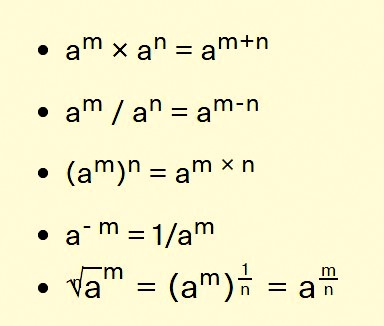
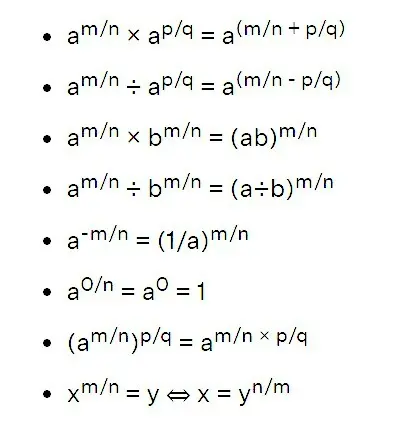
Rational Exponents
Rational exponents are exponents of numbers that are expressed as rational numbers, that is, in ap/q, a is the base and p/q is the rational exponent where q ≠ 0
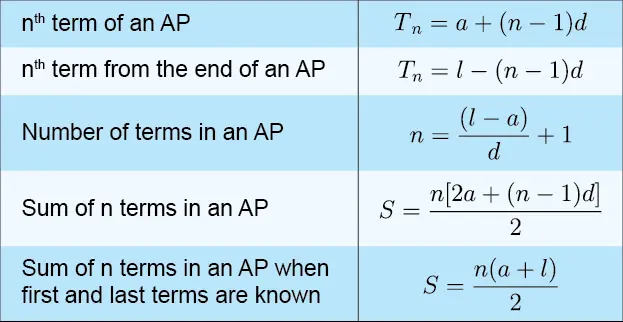
general form of an arithmetic progression is a,a+d,a+2d,a+3d,......,a+(n−1)da,a+d,a+2d,a+3d,......,a+(n−1)d.
Where,
aa = first term
dd = common difference
nn = number of terms in the Arithmetic Progression
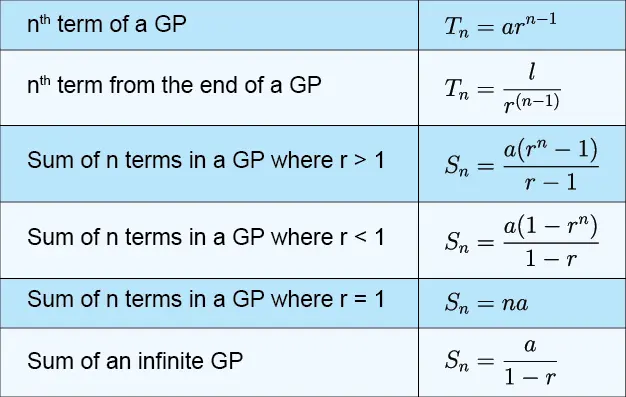
Similarly, we know that the ratio of any two consecutive numbers in a GP is always constant. So, to know the value of the next term in a GP, we have to multiply the previous term with the common ratio. So, the general form of a Geometric Progression is a,ar,ar2,ar3,......,arn−1a,ar,ar2,ar3,......,arn−1.
Similarly, we know that the ratio of any two consecutive numbers in a GP is always constant. So, to know the value of the next term in a GP, we have to multiply the previous term with the common ratio. So, the general form of a Geometric Progression is a,ar,ar2,ar3,......,arn−1a,ar,ar2,ar3,......,arn−1.
Where,
aa = first term
rr= common ratio
nn = number of terms in the Geometric Progression
Trigonometry Formula


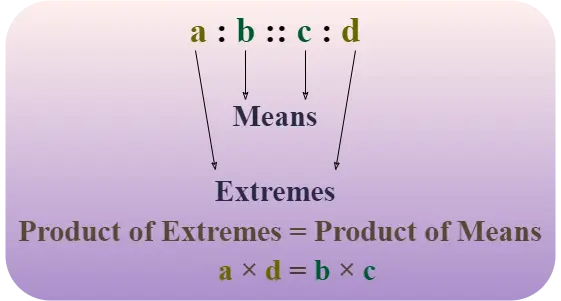
Ratio and Proportion Formula
The Ratio and Proportion Formula is used to express the relationship between two quantities or compare their sizes.
The two numbers in a ratio can only be compared when they have the same unit. We make use of ratios to compare two things. The sign used to denote a ratio is ‘:’
Important Properties of Proportion
The following are the important properties of proportion:
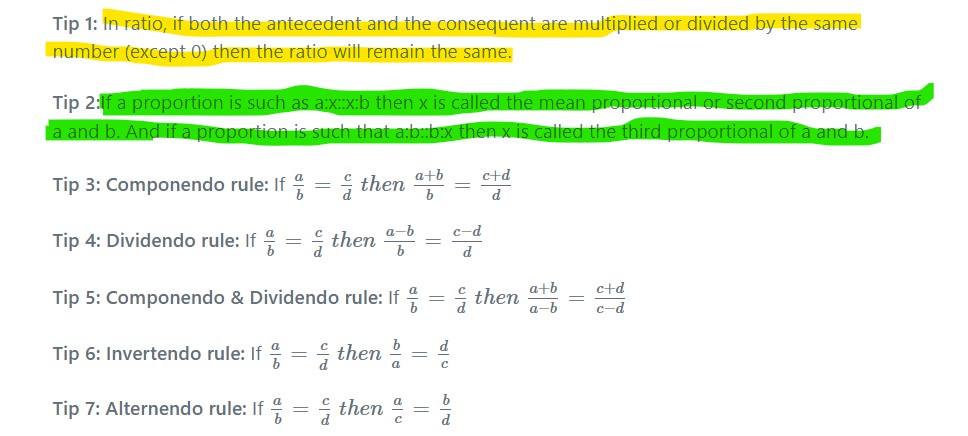
- Addendo – If a : b = c : d, then a + c : b + d
- Subtrahendo – If a : b = c : d, then a – c : b – d
- Dividendo – If a : b = c : d, then a – b : b = c – d : d
- Componendo – If a : b = c : d, then a + b : b = c+d : d
- Alternendo – If a : b = c : d, then a : c = b: d
- Invertendo – If a : b = c : d, then b : a = d : c
- Componendo and dividendo – If a : b = c : d, then a + b : a – b = c + d : c – d
| S.No | Ratio | Proportion |
| 1 | The ratio is used to compare the size of two things with the same unit | The proportion is used to express the relation of two ratios |
| 2 | It is expressed using a colon (:), slash (/) | It is expressed using the double colon (::) or equal to the symbol (=) |
| 3 | It is an expression | It is an equation |
| 4 | Keyword to identify ratio in a problem is “to every” | Keyword to identify proportion in a problem is “out of” |
Fourth, Third and Mean Proportional
If a : b = c : d, then:
- d is called the fourth proportional to a, b, c.
- c is called the third proportion to a and b.
- Mean proportional between a and b is √(ab).
Comparison of Ratios
If (a:b)>(c:d) = (a/b>c/d)
The compounded ratio of the ratios: (a : b), (c : d), (e : f) is (ace : bdf).
Duplicate Ratios
If a:b is a ratio, then:
- a2:b2 is a duplicate ratio
- √a:√b is the sub-duplicate ratio
- a3:b3 is a triplicate ratio
The proportion can be classified into the following categories, such as:
- Direct Proportion
- Inverse Proportion
- Continued Proportion
Now, let us discuss all these methods in brief:
Direct Proportion
The direct proportion describes the relationship between two quantities, in which the increases in one quantity, there is an increase in the other quantity also. Similarly, if one quantity decreases, the other quantity also decreases. Hence, if “a” and “b” are two quantities, then the direction proportion is written as a∝b.
Inverse Proportion
The inverse proportion describes the relationship between two quantities in which an increase in one quantity leads to a decrease in the other quantity. Similarly, if there is a decrease in one quantity, there is an increase in the other quantity. Therefore, the inverse proportion of two quantities, say “a” and “b” is represented by a∝(1/b).
Continued Proportion
Consider two ratios to be a: b and c: d.
Then in order to find the continued proportion for the two given ratio terms, we convert the means to a single term/number. This would, in general, be the LCM of means.
For the given ratio, the LCM of b & c will be bc.
Thus, multiplying the first ratio by c and the second ratio by b, we have
First ratio- ca:bc
Second ratio- bc: bd
Thus, the continued proportion can be written in the form of ca: bc: bd
Percentage
Percentage: In mathematics, a percentage is a figure or ratio that signifies a fraction out of 100. It is a method used to express a dimensionless relationship between two numbers, similar to ratios, fractions, and decimals. Percentages are commonly indicated by the symbol “%” following the number.
A fraction whose denominator is 100 is called a Percent i.e. in all the fractions where the denominator is 100 we can remove the denominator and put the % sign.
For example, the fraction 23/100 can be written as 23%. The opposite of this is also true i.e. any percentage sign can be easily replaced by converting the number into a fraction with the denominator 100. For example, 45% can be converted to a fraction as 45/100.
Percentage Formula
Percentage formula is a formula that is used to find the amount or share of a quantity in terms of a hundred. So, for calculating the percentage, we basically need three variables. First, the total value V1, the present value V2, and the percentage value P. The algebraic equation for this will be:
Percentage (P%) = (Parts (V2) / Whole (V1)) × 100
| S.no | Ratio | Fraction | Percent(%) | Decimal |
| 1 | 1:1 | 1/1 | 100 | 1 |
| 2 | 1:2 | 1/2 | 50 | 0.5 |
| 3 | 1:3 | 1/3 | 33.333 | 0.3333 |
| 4 | 1:4 | 1/4 | 25 | 0.25 |
| 5 | 1:5 | 1/5 | 20 | 0.20 |
| 6 | 1:6 | 1/6 | 16.667 | 0.16667 |
| 7 | 1:7 | 1/7 | 14.285 | 0.14285 |
| 8 | 1:8 | 1/8 | 12.5 | 0.125 |
| 9 | 1:9 | 1/9 | 11.111 | 0.11111 |
| 10 | 1:10 | 1/10 | 10 | 0.10 |
| 11 | 1:11 | 1/11 | 9.0909 | 0.0909 |
| 12 | 1:12 | 1/12 | 8.333 | 0.08333 |
| 13 | 1:13 | 1/13 | 7.692 | 0.07692 |
| 14 | 1:14 | 1/14 | 7.142 | 0.07142 |
| 15 | 1:15 | 1/15 | 6.66 | 0.0666 |
| Fractions | Percentage |
| 1/2 | 50% |
| 1/3 | 33.33% |
| 1/4 | 25% |
| 1/5 | 20% |
| 1/6 | 16.66% |
| 1/7 | 14.28% |
| 1/8 | 12.5% |
| 1/9 | 11.11% |
| 1/10 | 10% |
| 1/11 | 9.09% |
| 1/12 | 8.33% |
| 1/13 | 7.69% |
| 1/14 | 7.14% |
| 1/15 | 6.66% |


Great stories have a personality. Consider telling a great story that provides personality. Writing a story with personality for potential clients will assist with making a relationship connection. This shows up in small quirks like word choices or phrases. Write from your point of view, not from someone else's experience.
Great stories are for everyone even when only written for just one person. If you try to write with a wide, general audience in mind, your story will sound fake and lack emotion. No one will be interested. Write for one person. If it’s genuine for the one, it’s genuine for the rest.
Mensuration
Mensuration is the branch of mathematics that studies the measurement of geometric figures and their parameters like length, volume, shape, surface area, lateral surface area, etc
| Mensuration Formulas for 2-Dimensional Figures | ||
| Shape | Area | Perimeter |
| Circle | πr² | 2 π r |
| Square | (side)² | 4 × side |
| Rectangle | length × breadth | 2 (length + breadth) |
| Scalene Triangle | √[s(s−a)(s−b)(s−c), Where, s = (a+b+c)/2 | a+b+c (sum of sides) |
| Isosceles Triangle | ½ × base × height | 2a + b (sum of sides) |
| Equilateral Triangle | (√3/4) × (side)² | 3 × side |
| Right Angled Triangle | ½ × base × hypotenuse | A + B + hypotenuse, where the hypotenuse is √A²+B² |
| Parallelogram | base × height | 2(l+b) |
| Rhombus | ½ × diagonal1 × diagonal2 | 4 × side |
| Trapezium | ½ h(sum of parallel sides) | a+b+c+d (sum of all sides) |
Differences Between 2D and 3D shapes
| 2D Shape | 3D Shape |
|---|---|
| If a shape is surrounded by three or more straight lines in a plane, then it is a 2D shape. | If a shape is surrounded by a no. of surfaces or planes then it is a 3D shape. |
| These shapes have no depth or height. | These are also called solid shapes and unlike 2D they have height or depth. |
| These shapes have only two dimensions say length and breadth. | These are called Three dimensional as they have depth (or height), breadth and length. |
| We can measure their area and Perimeter. | We can measure their volume, Curved Surface Area (CSA), Lateral Surface Area (LSA), or Total Surface Area (TSA). |
Differences Between 2D and 3D shapes
| 2D Shape | 3D Shape |
|---|---|
| If a shape is surrounded by three or more straight lines in a plane, then it is a 2D shape. | If a shape is surrounded by a no. of surfaces or planes then it is a 3D shape. |
| These shapes have no depth or height. | These are also called solid shapes and unlike 2D they have height or depth. |
| These shapes have only two dimensions say length and breadth. | These are called Three dimensional as they have depth (or height), breadth and length. |
| We can measure their area and Perimeter. | We can measure their volume, Curved Surface Area (CSA), Lateral Surface Area (LSA), or Total Surface Area (TSA). |


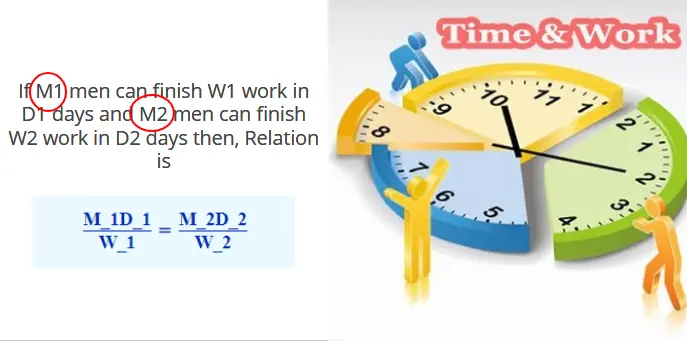
Time and Work
Important Time and Work Formula
Knowing the formulas can completely link you to a solution as soon as you read the question. Thus, knowing the formula for any numerical ability topic make the solution and the related calculations simpler.
Given below are a few such important time and work formulas for your reference:
- Work Done = Time Taken × Rate of Work
- Rate of Work = 1 / Time Taken
- Time Taken = 1 / Rate of Work
- If a piece of work is done in x number of days, then the work done in one day = 1/x
- Total Wok Done = Number of Days × Efficiency
- Efficiency and Time are inversely proportional to each other
- X:y is the ratio of the number of men which are required to complete a piece of work, then the ratio of the time taken by them to complete the work will be y:x
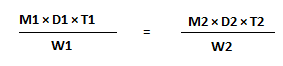
- If x number of people can do W1 work, in D1 days, working T1 hours each day and the number of people can do W2 work, in D2 days, working T2 hours each day, then the relation between them will be
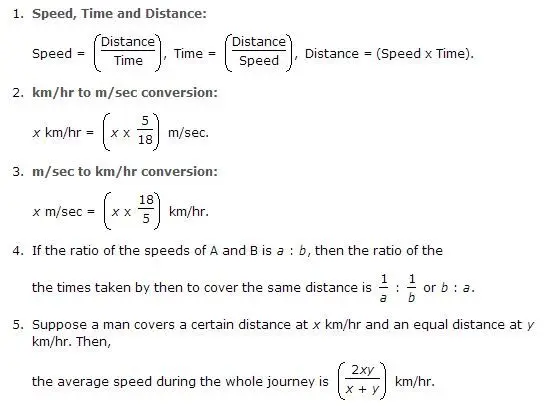


Speed, Time & Distance
Speed, Time & Distance Conversions
- To convert from km / hour to m / sec, we multiply by 5 / 18. So, 1 km / hour = 5 / 18 m / sec
- To convert from m / sec to km / hour, we multiply by 18 / 5. So, 1 m / sec = 18 / 5 km / hour = 3.6 km / hour
- Similarly, 1 km/hr = 5/8 miles/hour
- 1 yard = 3 feet
- 1 kilometer= 1000 meters = 0.6214 mile
- 1 mile= 1.609 kilometer
- 1 hour= 60 minutes= 60*60 seconds= 3600 seconds
- 1 mile = 1760 yards
- 1 yard = 3 feet
- 1 mile = 5280 feet
- 1 mph = (1 x 1760) / (1 x 3600) = 22/45 yards/sec
- 1 mph = (1 x 5280) / (1 x 3600) = 22/15 ft/sec
- For a certain distance, if the ratio of speeds is a : b, then the ratio of times taken to cover the distance would be b : a and vice versa.
The concept of Speed, Time and Distance is used extensively for questions relating to different topics such as motion in a straight line, circular motion, boats and streams, races, clocks, etc.
Relationship Between Speed, Time & Distance
- Speed = Distance/Time – This tells us how slow or fast an object moves. It describes the distance travelled divided by the time taken to cover the distance.
- Speed is directly Proportional to Distance and Inversely proportional to Time. Hence,
- Distance = Speed X Time, and
- Time = Distance / Speed, as the speed increases the time taken will decrease and vice versa.
Great stories have a personality. Consider telling a great story that provides personality. Writing a story with personality for potential clients will assist with making a relationship connection. This shows up in small quirks like word choices or phrases. Write from your point of view, not from someone else's experience.
Great stories are for everyone even when only written for just one person. If you try to write with a wide, general audience in mind, your story will sound fake and lack emotion. No one will be interested. Write for one person. If it’s genuine for the one, it’s genuine for the rest.
Simple and Compound Interest
Interest Formulas for SI and CI
The Interest formulas are given as,
| Formulas for Interests (Simple and Compound) | |
|---|---|
| SI Formula | S.I. = Principal × Rate × Time |
| CI Formula | C.I. = Principal (1 + Rate)Time − Principal |
| Time | Simple interest Formula | Explanation |
| Years | PTR/100 | T = Number of years |
| Months | (P × n × R)/ (12 ×100) | n = Number of months |
| Days | (P × d × R)/ (365 ×100) | d = Number of days (non-leap year) |
Simple interest formula is given as:
SI=PTR/100
Where SI = simple interest
P = principal
R = interest rate (in percentage)
T = time duration (in years)
In order to calculate the total amount, the following formula is used:
Amount (A) = Principal (P) + Interest (I)
Where,
Amount (A) is the total money paid back at the end of the time period for which it was borrowed.
The total amount formula in case of simple interest can also be written as:
A = P(1 + RT)
Formula of Compound Amount
For an initial principal of P, rate of interest per annum of r (r%), time period t in years, frequency of the number of times the interest is compounded annually n, the formula to calculate the total compounded amount is as follows:
A = P (1 + r/n)nt
Formula of Compound Interest
The compound interest is obtained by subtracting the principal amount from the compound amount. Hence, the formula to find just the compound interest is as follows: CI = P (1 + r/n)/ - P.
Compound amount, A = P(1 + r)nt
Compound interest, C.I = P(1 + r)t - P

POLYGON FORMULA
